I almost forgot about this years Perseid Meteors. It was about 11pm when I remembered. I had to get up early for work in the morning so I couldn't really stay out too late but we went into the back garden for a few minutes, long enough for us to see a couple of bright meteors streak through the sky.
The cartoon below came from a newspaper many years ago (probably the News of the World but I can't remember now).
I had spent most of my time photographing the previous eclipses, so this time I decided to video this one. I had two camcorders set up, one with the zoom at the wide angled end, to record the path of the moon as it passed into the Earth's shadow. The other camera was fitted with a telephoto adapter, and I recorded a few second of film every few minutes. The output from these cameras was turned into two time lapse films:
- close-up.mpg (308Kb) - a short (19s) clip of the shadow falling across the face of the moon.
- out_of_eclipse.mpg (254Kb) - the wide-angled view, showing the moon coming out of the Earth's shadow.
The eclipse itself was an orange/brown colour, rather than the bright red colour of previous eclipses. Unfortunately, the video cameras weren't sensitive enough to show the colours clearly.
Both films were shot using normal VHS camcorders. The close-up view was captured using a camera fitted with a telephoto adapter, mounted on a normal photographic tripod. The tripod was regularly adjusted to keep the moon in the centre of the frame (next time, I will mount the camera on my telescope and use the motor drive, but the scope was unavailable at the time). The cameras exposure was altered to account for the changing brightness of the moon, otherwise the automatic exposure would overexpose the bright areas.
On the morning of Wednesday 11th August 1999, there was a total solar eclipse visible from Cornwall, south Devon, and across parts of Europe. I was luck enough to be staying on the Lizard Peninsular, in the far south of Cornwall.
After a whole week of clear skies, the morning of the eclipse started cloudy. It remained that way , but about two minutes before totality, a small gap appeared in the clouds just in the right place for the sun to shine through. I got a glimpse of a thin crescent of the sun for a few seconds before the clouds rolled over again. By this time, it had started to go dark, and get slightly colder than before. The start of totality was obscured by clouds, but about 1 minute in, the clouds drifted away again, allowing us to see the eclipsed sun.
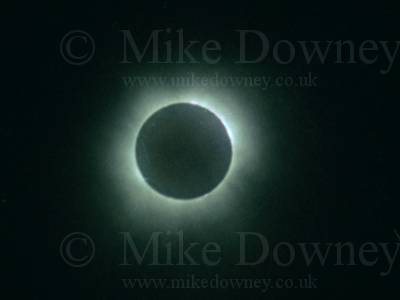
Totality only lasted for two minutes, so that was half of the eclipse lost due to cloud. The rest of the eclipse stayed clear, and I stood next to my camera, just pressing the shutter, then altering the exposure and taking another photo.
All of the photographs were taken using a Nikon FM, fitted with a Vivitar 75-205mm zoom lens, at the 205mm end. The film was Kodak Gold 100, and the exposures ranged from 1/500 to 1/4 s at f/8. For the minute where the eclipse was visible, I took a range of photographs with the range of shutter speeds mentioned above. The photo above was from the middle of the range - everything happened too quickly for me to actually make a note of the exposure used.
Unfortunately, although there was a gap in the clouds which the eclipse was shining through, there was also a thin layer of cloud lying in front which meant that the longer exposures picked up the cloud being lit up, rather than the solar corona. This also led to Baily's Beads and the Diamond Ring effect to be slightly obscured.
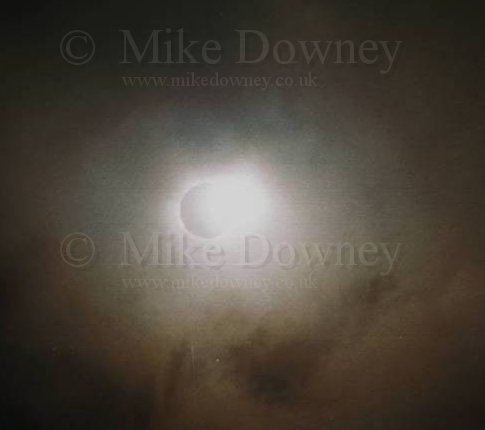
The picture above was an attempt to photograph the Diamond Ring effect. The exposure was about 1/500 to 1/2000s, but the sunlight shining around the disk of the moon has also lit up the clouds.
All the Hale-Bopp photographs shown here were taken from Anglesey mostly during March and April 1997. Details about the film and exposure accompany each image. Most of these were taken with a telephoto lens with camera 'piggy-backed' onto the telescope, to keep the comet centred during the exposure.


Click on the thumbnail to view the image
All of the photographs shown here were taken during the total lunar eclipse of the 26/27th of September 1996. Unfortunetely, here in Britain, we had to wait until the early hours of the morning, but since I missed the April eclipse due to cloudy weather, I made sure I saw this one.
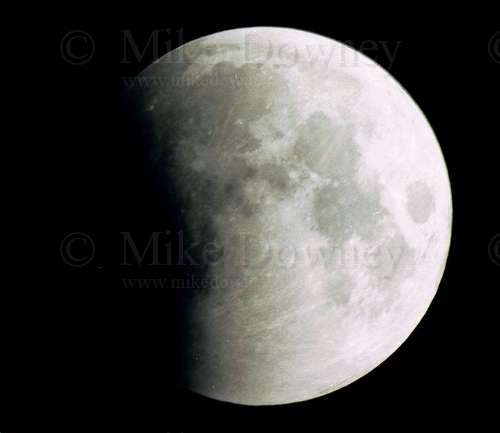
The first photograph was taken at 01:24 UT, as the Earth's shadow was starting to move across the moon. The exposure was 1/500s on Fujichrome 400 film, through a Meade LX50 8" f/10. (These photos have been recently re-scanned using my new Epson Filmscan 200, so the results are better than my old hand-held scanner.)
This was the first lunar eclipse I had seen since I bought my telescope, so I took as many photographs as I could, to increase my chances of getting some good ones. The two main photos here are probably the best of the lot - they were much better than I was expecting.
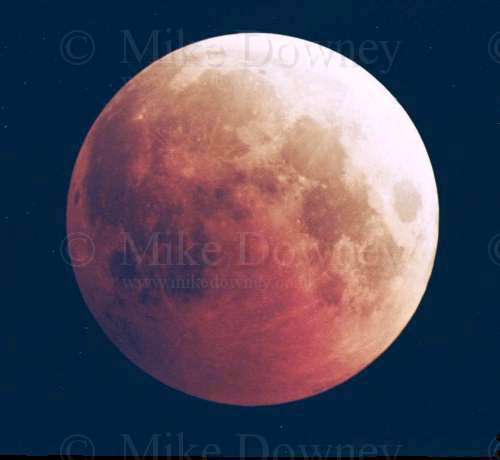
The second photo was taken at 02:30 UT, just as the moon was entering the 'total' stage of the eclipse. The exposure was 5 seconds, again on Fujichrome 400.
I was surprised how light the eclipse was. According to the photographic exposures (1/1000s for full moon to 5s for eclipsed), there was a 5000fold decrease in light level, but the moon still looked a bright orange colour. The sky didn't get dark enough for me to see the milky way, which I can normally see very easily from Anglesey on moonless nights. Bright nebulae, such as M42, were clearly visible through the telescope.
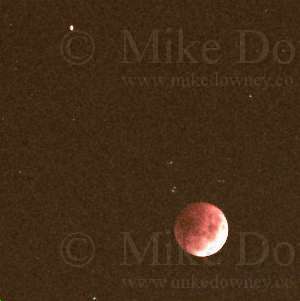
This third photograph was taken through a 200mm telephoto lens, and shows the eclipsed moon and Saturn in the same field of view.
The photograph here was taken in 1996 and shows the comet before it approached Earth. This was actually a 'practice piggyback' photo, and it wasn't until much later that I found out that I had photographed the comet!
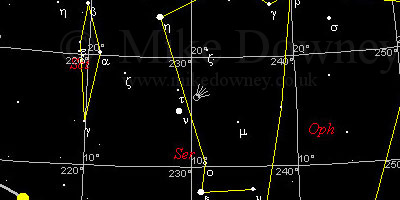
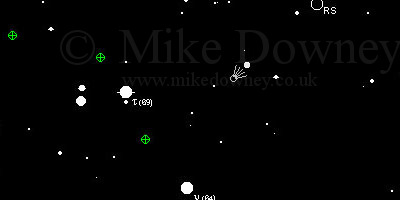
This shows the part of the sky where the comet was in august 1996. (Star charts created using SkyMap Pro.)
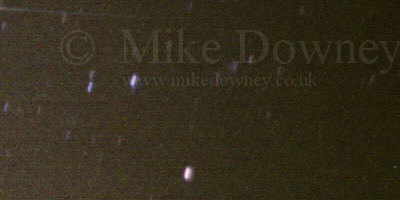
The above shows the comet (which is visible as a fuzzy blob between two stars). The stars are visible as small trails because the telescope wasn't polar aligned accurately enough - the exercise was to practice taking piggy-backed photos, the presence of the comet was an added bonus. The chart below shows the location of the comet.