
All of the photographs shown here were taken during the total lunar eclipse of the 26/27th of September 1996. Unfortunetely, here in Britain, we had to wait until the early hours of the morning, but since I missed the April eclipse due to cloudy weather, I made sure I saw this one.
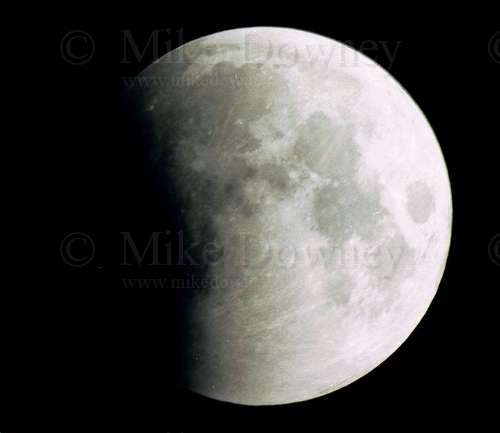
The first photograph was taken at 01:24 UT, as the Earth's shadow was starting to move across the moon. The exposure was 1/500s on Fujichrome 400 film, through a Meade LX50 8" f/10. (These photos have been recently re-scanned using my new Epson Filmscan 200, so the results are better than my old hand-held scanner.)
This was the first lunar eclipse I had seen since I bought my telescope, so I took as many photographs as I could, to increase my chances of getting some good ones. The two main photos here are probably the best of the lot - they were much better than I was expecting.
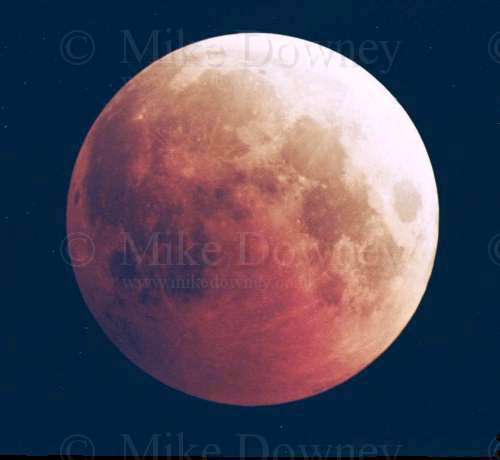
The second photo was taken at 02:30 UT, just as the moon was entering the 'total' stage of the eclipse. The exposure was 5 seconds, again on Fujichrome 400.
I was surprised how light the eclipse was. According to the photographic exposures (1/1000s for full moon to 5s for eclipsed), there was a 5000fold decrease in light level, but the moon still looked a bright orange colour. The sky didn't get dark enough for me to see the milky way, which I can normally see very easily from Anglesey on moonless nights. Bright nebulae, such as M42, were clearly visible through the telescope.
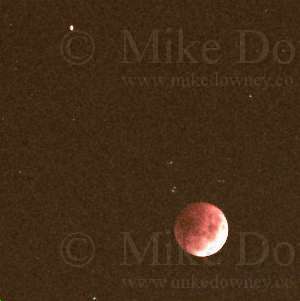
This third photograph was taken through a 200mm telephoto lens, and shows the eclipsed moon and Saturn in the same field of view.